

{{ name }}
Article no. {{ combinedCodeWithHighlight }}
Article code:
EAN / GTIN:
Manufacturer number:
Cat. No.:

Whether it’s broaching or slotting, there are different ways to get the perfect profile or slot. We provide an overview of different methods, examine their advantages and disadvantages and explain when it would be best to use which method. We are focusing on the two production methods that deliver the greatest benefits for you. The selected methods eliminate the need for complex work steps such as spark erosion or re-clamping the workpiece on a different machine, and you won’t be reliant on the restrictive use of a broach any more either.
| Method | Size | Position | Shape | Example from production |
|---|---|---|---|---|
| Profile broaching (tumbling) | Small profiles | Internal and external | Complex profiles | Production of internal splines, keyways and complex internal profiles |
| Profile slotting | Large profiles | Internal and external | Hexagonal, square and special profiles | Production of hexagonal profiles for screw heads, square profiles for toolholders |
| Keyway broaching | Variable | Internal and external | Straight slots, feather key slots, spline shafts | Production of feather key slots in shafts and hubs, spline shaft profiles |
Profile broaching, also called tumbling, is a machining process. With this method, a profile broaching insert moves concentrically (in a tumbling or wobbling motion) to produce the desired profile in a single work step. When producing internal profiles, this turns the hole into a square socket profile, toothed hub profile or double-square profile. When producing external profiles, a special cutter insert on the profile broaching holder quickly produces an external hexagon profile, for example, from a pin-shaped workpiece.
Overview of advantages and disadvantages:
The steps required to produce internal profiles are extensive. To begin with, you need a suitable hole in the workpiece. This preliminary hole should be as large as possible to minimise the machining time and protect the cutting edge. The hole also needs to be deeper to ensure the material can be displaced.
The actual broaching process can now start: step by step, the tool gradually shapes the hole as required. Tips on the best way to use broaching on lathes and milling machines and an overview of the relevant reference values for the hole diameter can be found here.
The process for producing external profiles is similar to that for producing internal profiles. The first step is to prepare the workpiece appropriately so as to create a pin with a radius diameter that is smaller than the profile you want to produce. It is important to provide a relief groove for displacing the material. You then move the profile broaching insert for external profiles up to the pin and the desired profile is cut in a single work step. You can find reference values for the workpiece diameter and suggestions for broaching external profileshere.
Do you already produce internal profiles on a lathe, but now also want to produce external profiles using the broaching method from time to time? Then our handy adapter solution is sure to be of interest to you. This adapter easily enables you to use your broaching holder for internal profiles in order to produce external profiles. Seeherefor further details.
However, we only recommend this adapter solution if you produce external profiles occasionally. If you do it regularly, you should use a broaching holder for external profiles for stability reasons.
No matter which method you choose, don’t forget to use coolants and lubricants because they reduce friction and extend the tool’s service life.
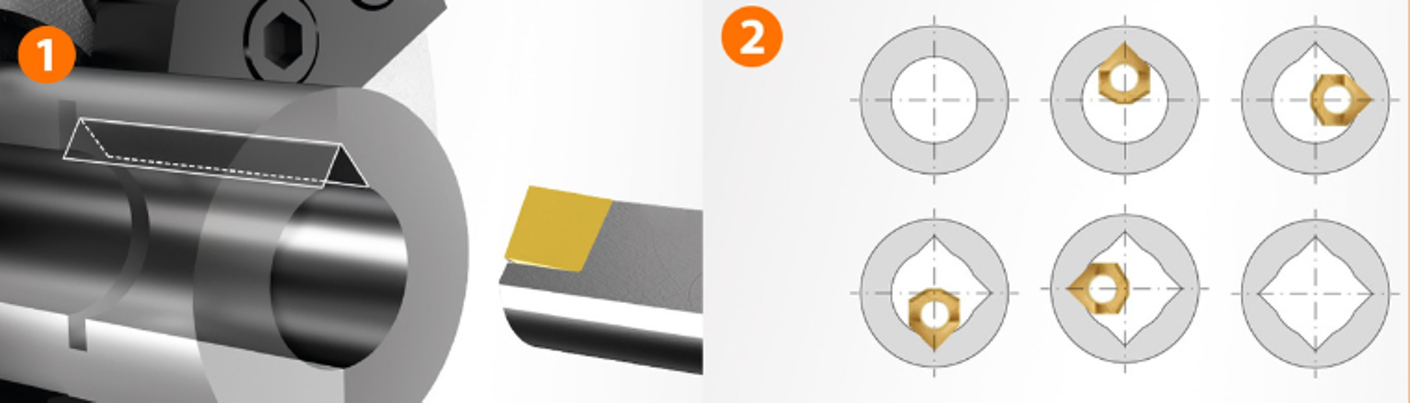
Profile slotting is another machining process used in production. This method uses a
profile slotting toolholder and a suitable cutter insert to produce different profiles.
You do not need a broach, and there is also no need to
re-clamp your workpiece – the profiles can be produced on a conventional CNC lathe (with a certain amount of manual effort you can, of course,
also do this on conventional lathes). If you need to meet particularly high requirements in terms of
the accuracy of fit, profile shape and profile width, you will need either a
lathe with a Y-axis or a special eccentric bush for the profile slotting toolholder.
Just like profile slotting, keyway broaching is a machining process used in production. It uses a keyway broaching toolholder and a suitable cutter insert. As above, this method eliminates the need for other machines as the keyways can be produced on CNC lathes and on machining centres.
With this method, the keyway is produced by the cutting movements on the Z-axis, while the clamping depth is determined by the movements on the X-axis. Keyway broaching is particularly useful when producing feather key slots and keyways.
If the keyway has to meet exacting requirements in terms of the accuracy of fit, then just like profile slotting you will need either a programmable Y-axis or an eccentric bush for the keyway broaching toolholder.
We would be pleased to advise you on which production method would be best for your Production department. You can find suitable tools here: